
A chargesheet filed by Andhra Pradesh police in connection with the Rs 3,500 crore alleged liquor scam mentions former chief minister YS Jagan Mohan Reddy as one of the recipients of kickbacks. The chargesheet alleges a complex scheme involving shell companies, policy manipulation, and extortion to generate funds that were ultimately routed to Jagan Mohan Reddy.

India's stock markets corrected recently but foreign money is likely to chase China rather than India in the short-to-medium term, said Chris Wood, global head of equity strategy at Jefferies, on Thursday. Wood told the Business Standard Manthan Summit in New Delhi he is bullish about Indian equities from a long-term perspective, but for the short term he is cautious given the quantum of foreign investor (FII) outflows and valuation woes.

India men's hockey team captain Harmanpreet Singh has two Olympic bronze medals in his cabinet, but rues missing out on World Cup glory.
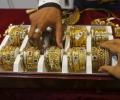
Nearly two-thirds of India's gold demand comes from rural areas where jewellery is a traditional store of wealth for millions who have no access to the formal banking system.


Investment consulting firm Millwood Kane International said on Tuesday that investments in gold gave gains of nearly 28 per cent in rupee terms during 2020 and will remain in focus for investors in the coming year. "The yellow metal has had a phenomenal year with gains of nearly 28 per cent in rupee terms. "After a double-digit gain in 2019, this will be the second year in a row that gold will be posting a stellar rise," said founder and CEO Nish Bhatt.

A downturn in Indian demand could hit global gold prices.

Escalating trade tensions amid a tariff war after Donald Trump took over as President of the United States (US) could adversely impact global growth and fuel inflation, an article on the "State of the Economy" in the Reserve Bank of India (RBI) monthly bulletin said.

Despite its recent underperformance, gold must be a part of your portfolio.

Commodity investments can help you diversify your portfolio in asset classes other than equity and debt, says Dwaipayan Bose.

The rise was due to a sharp fall in prices, which spurred demand.

Silver also recorded a significant rise of Rs 960 to Rs 39,250 per kg on increased offtake by industrial units and coin makers.

India's craft chocolate makers are changing the market by using local cacao, creating bold new flavours, making chocolate both a luxury and a story.

Merchandise exports to the US jumped 23.5 per cent year-on-year (Y-o-Y) to $8.3 billion in June, even as India's overall outbound shipments witnessed contraction during the month, according to the data released by the commerce department on Tuesday. The increase in outbound shipments to the US was largely driven by the rush among exporters to utilise America's pause on its plans to impose country-specific reciprocal tariffs.

Meanwhile, retail jewellery sales in India have declined by 50 per cent since gold price started its uptrend nearly two weeks. Buyers deferred their fresh purchase amid expectations of a correction in gold prices from the current high level.

In 2022, gold emerged as the top performer among all conventional asset classes with over 14 per cent returns mainly owing to the depreciation of the rupee.

Snapping their three-day falling trend, gold prices surged by Rs 375 to trade at Rs 26,375 per 10 grams at the bullion market.

In the face of imminent US recession, fears of gold falling during recession are rife.

Another trend: A preference for coloured diamonds among brides, who are pairing them with their groom's birthstone. So, along with yellow or white diamonds, they are choosing pink, green, blue sapphires, emeralds or red rubies.

The world's most coveted handbag is back in the spotlight.
High gold prices let Indians feel wealthier and spend more, making monetary policy less effective.

The star-studded 12-man event, to be held at the Sree Kanteerava Stadium, will feature seven of the best javelin throwers in the world and five Indians, including Chopra.

Gold prices declined by Rs 50 to Rs 28,270 per ten grams in New Delhi on Monday on slackened demand from jewellers at prevailing levels amid a weak trend in global markets.

Jewellery stores remained deserted as buyers deferred their non-essential purchases awaiting softness in gold prices.

After two days of gains, gold prices fell by Rs 60 to close at Rs 27,400 per 10 gram in New Delhi on Wednesday due to slackened demand from jewelers and retailers amid absence of cues from global markets.

Stocks of gold jewellery retailers have been able to retain their sheen in 2023 despite volatile gold prices. Kalyan Jewellers, Titan, PC Jewellers, Thangamayil Jewellery, and Tribhovandas Bhimji Zaveri (TBZ) have rallied 21-72 per cent so far since April as compared to a 13 per cent gain in the benchmark Sensex index. The rally gained steam on the back of gold's 6 per cen

The demand for gold has bounced back sharply in India from the lows seen in 2020 because of the outbreak of the Covid-19 pandemic, and has even beaten the pre-pandemic level. In the September quarter, the demand for gold jumped 47 per cent year-on-year (YoY) to 139.1 tonnes, as against 94.6 tonnes in the year-ago period, and higher than the 123.9 tonnes recorded in the pre-pandemic September 2019 quarter, the World Gold Council (WGC) said in its latest release. In value terms, demand surged 37 per cent year-on-year (YoY) to Rs 59,330 crore during the quarter.

These companies may recall loans in extreme cases; loan-to-value ratio stands at 60% but scrap value at 75%.

By threatening to punish India with high tariff, Trump is actually planting a tantalising thought in the Indian mind that the Modi government should suitably 'incentivise' him, explains Ambassador M K Bhadrakumar.

India's gold demand declined 18 per cent to 135.5 tonnes in the first three months of this year, mainly due to a sharp rise in prices, according to the World Gold Council (WGC). The demand stood at 165.8 tonnes in the first three months of 2021. In terms of value, gold demand dropped 12 per cent to Rs 61,550 crore in the January-March period. It stood at Rs 69,720 crore in the year-ago period, the 'Gold Demand Trends Q1 2022' report released by the WGC said.
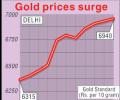

Gold-silver ratio indicates more upsurge possible for the white metal.
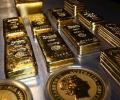
Investors pumped Rs 491 crore in gold exchange traded funds (ETFs) in February as they seem be taking advantage of the lower domestic prices caused due to declining international rates, appreciating rupee and reduction in custom duty. This came following a net investment of Rs 625 crore in January and Rs 431 crore in December. Prior to this, gold ETFs had seen an outflow of Rs 141 crore in November, data available with Association of Mutual Funds in India showed.

'Each state is unique, but when it comes to finance, the fundamentals cannot be different.'

The sharp jump in shares of Kalyan Jewellers (Kalyan) has surprised many on the Street; however, analysts believe more steam could be left in the stock as the Thrissur-based gold retailer pivots to a new asset-light network expansion model. Kalyan's stock has surged 62 per cent in the past month, even as the S&P BSE SmallCap Index has gained just 5 per cent. In its latest business update, the company said its consolidated sales grew more than consensus expectations at 31 per cent year-on-year, led by strong domestic sales regardless of the volatility in gold prices.
There is good news and even better news for gold consumers - prices of the precious metal have fallen to a nine-month low of Rs 8,725 per ten grams right ahead of the marriage season and are set to dip further in the coming weeks.

Tough times don't last, but tough people -- and smart financial strategies - do, says Ramalingam Kalirajan
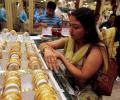
Jewellers in India, the world's second largest gold consuming country after China, have started receiving more inquiries for purchase of gold or silver immediately after the Reserve Bank's announcement to withdraw Rs 2,000 notes from circulation. However, there is no panic buying of the precious metal unlike the situation witnessed in 2016 during demonetisation, jewellers body GJC said on Sunday. In fact in the last two days, the actual gold purchase has been less in exchange of Rs 2,000 notes due to strict Know your Customer (KYC) norms although sources said some jewellers have started charging a 5-10 per cent premium, taking the gold prices to Rs 66,000 per 10 grams level.
In domestic market, gold prices had peaked to Rs 39,011 per 10 grams in September and are now ruling at Rs 38,800 per 10 gram.

Irrespective of the global movement, gold prices in India are nearing the level of Rs 34,000 per 10 grams in the physical markets.
